Build what law needs next
Build what law needs next
Build what law needs next
A one-day hackathon at BI Norwegian Business School on October 22, where lawyers, technologists, and students team up to put AI to work on real legal problems, from contract review to access to justice.
A one-day hackathon at BI Norwegian Business School on October 22, where lawyers, technologists, and students team up to put AI to work on real legal problems, from contract review to access to justice.

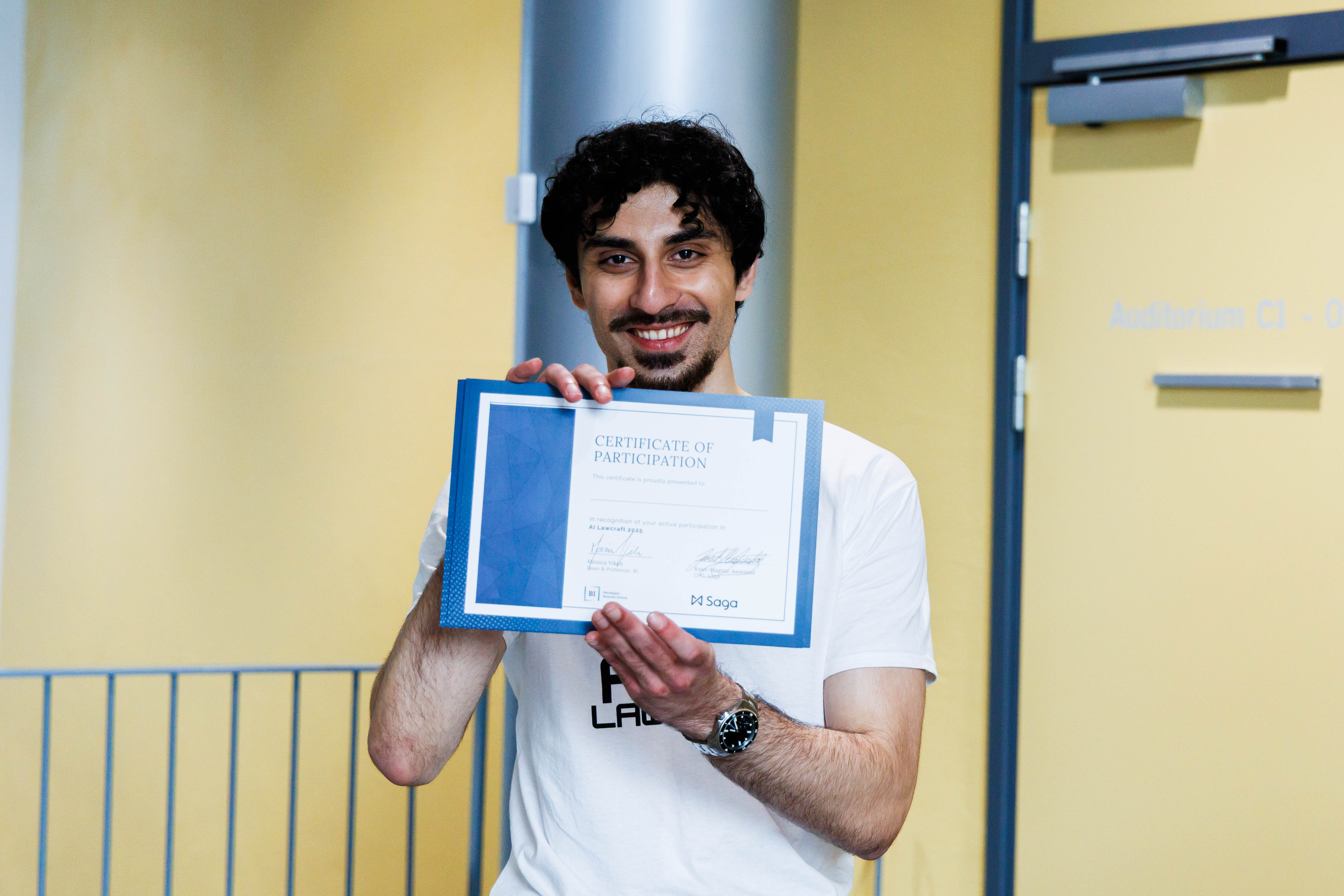
Photos from AI Lawcraft 2026
A look back at our day at BI Startup Village in Oslo on 22 October 2026.
See and download all photosCountdown till our next hackaton!
Countdown till our next hackaton!
00:00:00:00
00:00:00:00
00:00:00:00
Countdown till our next hackaton!
00:00:00:00
00:00:00:00
AI Lawcraft in Juristen
Juristen wrote about AI Lawcraft and how students, lawyers and technologists meet to build the future of legal work.
The article is in Norwegian.
Read the article“Der vi tenner gnisten og starter treningen av fremtidens jurister.”
BI Norwegian Business School
BI Norwegian Business School

BI Norwegian Business School
BI Norwegian Business School
BI Norwegian Business School
BI Norwegian Business School
BI Norwegian Business School
BI Norwegian Business School
Location: BI, Campus Oslo
When: October 22nd
Who: Students and professionals interested in law and technology
Format: Group-based hackathon: build legal workflows using AI agents, databases, and prompting
Sign-up fee: None
Location: BI, Campus Oslo
When: October 22nd
Who: Students and professionals interested in law and technology
Format: Group-based hackathon: build legal workflows using AI agents, databases, and prompting
Sign-up fee: None
How does the Legal hackathon work?
How does the Legal hackathon work?
The hackathon focuses on real challenges faced in legal practice. Rather than starting with a predefined solution, teams are first asked to identify and clearly define a challenge faced by lawyers and legal teams in their day-to-day work and then design an AI-powered solution using SAGA platform and other tools.
⚖️ Challenge Approach: From Problem to Solution
Each team will:
Identify a real legal pain point
Examples include inefficiencies, risks, repetitive tasks, lack of transparency, or decision-making challenges in legal work.Define the problem clearly
Teams are expected to articulate:who the user is (lawyer, in-house counsel, compliance team, etc.),
where the problem occurs in the legal workflow, and why current solutions are insufficient.
Design an AI-assisted legal solution
Using the platform’s tools, teams will translate their problem into a structured, testable solution.
🧩 Tools You Will Use
Participants will build their solutions using:
Legal workflows – structuring complex legal processes step by step
AI assistants & agents – assigning roles and responsibilities to AI (e.g. reviewer, challenger, drafter)
Grid reviews – structured extraction of key legal information from documents
🧠 Skills You Will Develop
Prompt engineering for legal work – crafting precise instructions for different legal tasks and roles
Process thinking – breaking down complex legal work into AI-assisted steps
Responsible AI usage – understanding limits, risks, and verification strategies
No coding is required, the focus is on legal reasoning, process design, and responsible AI use.
🎯 What We’re Looking For
Teams will be evaluated on:
clarity and relevance of the problem definition,
how well the solution fits real legal workflows,
effective and creative use of AI tools,
transparency and reliability of the outputs, and
overall practicality and impact.
Below, you will find extra information regarding the foundation of the competition. It will be useful to review this before you start working and before you have created a plan for how you intend to approach the task.
🏆 Award
1st place
The winning team receives:
Conference Tickets to FutureLaw 2027 in Tallinn, 27–28 May 2027. FutureLaw is one of the largest legal innovation conferences in Northern Europe. It has two days of talks and expert workshops on AI, automation and the future of legal practice.
The book Postkort fra fremtiden from Finansavisen Bok , worth 598 kr.
One month of Allvit+, which gives digital access to academic books and textbooks.
2nd place receives:
Breakfast giftcard at Thon Hotel


How does the Legal hackathon work?
How does
the Legal hackathon work?
The hackathon focuses on real challenges faced in legal practice. Rather than starting with a predefined solution, teams are first asked to identify and clearly define a challenge faced by lawyers and legal teams in their day-to-day work and then design an AI-powered solution using SAGA platform and other tools.
⚖️ Challenge Approach: From Problem to Solution
Each team will:
Identify a real legal pain point
Examples include inefficiencies, risks, repetitive tasks, lack of transparency, or decision-making challenges in legal work.Define the problem clearly
Teams are expected to articulate:who the user is (lawyer, in-house counsel, compliance team, etc.),
where the problem occurs in the legal workflow, and why current solutions are insufficient.
Design an AI-assisted legal solution
Using the platform’s tools, teams will translate their problem into a structured, testable solution.
🧩 Tools You Will Use
Participants will build their solutions using:
Legal workflows – structuring complex legal processes step by step
AI assistants & agents – assigning roles and responsibilities to AI (e.g. reviewer, challenger, drafter)
Grid reviews – structured extraction of key legal information from documents
🧠 Skills You Will Develop
Prompt engineering for legal work – crafting precise instructions for different legal tasks and roles
Process thinking – breaking down complex legal work into AI-assisted steps
Responsible AI usage – understanding limits, risks, and verification strategies
No coding is required, the focus is on legal reasoning, process design, and responsible AI use.
🎯 What We’re Looking For
Teams will be evaluated on:
clarity and relevance of the problem definition,
how well the solution fits real legal workflows,
effective and creative use of AI tools,
transparency and reliability of the outputs, and
overall practicality and impact.
Below, you will find extra information regarding the foundation of the competition. It will be useful to review this before you start working and before you have created a plan for how you intend to approach the task.
🏆 Award
1st place
The winning team receives:
Conference Tickets to FutureLaw 2027 in Tallinn, 27–28 May 2027. FutureLaw is one of the largest legal innovation conferences in Northern Europe. It has two days of talks and expert workshops on AI, automation and the future of legal practice.
The book Postkort fra fremtiden from Finansavisen Bok, worth 598 kr.
One month of Allvit+, which gives digital access to academic books and textbooks.
2nd place receives:
Breakfast giftcard at Thon Hotel
How does the Legal hackathon work?
How does the Legal hackathon work?
The hackathon focuses on real challenges faced in legal practice. Rather than starting with a predefined solution, teams are first asked to identify and clearly define a challenge faced by lawyers and legal teams in their day-to-day work and then design an AI-powered solution using SAGA platform and other tools.
⚖️ Challenge Approach: From Problem to Solution
Each team will:
Identify a real legal pain point
Examples include inefficiencies, risks, repetitive tasks, lack of transparency, or decision-making challenges in legal work.Define the problem clearly
Teams are expected to articulate:who the user is (lawyer, in-house counsel, compliance team, etc.),
where the problem occurs in the legal workflow, and why current solutions are insufficient.
Design an AI-assisted legal solution
Using the platform’s tools, teams will translate their problem into a structured, testable solution.
🧩 Tools You Will Use
Participants will build their solutions using:
Legal workflows – structuring complex legal processes step by step
AI assistants & agents – assigning roles and responsibilities to AI (e.g. reviewer, challenger, drafter)
Grid reviews – structured extraction of key legal information from documents
🧠 Skills You Will Develop
Prompt engineering for legal work – crafting precise instructions for different legal tasks and roles
Process thinking – breaking down complex legal work into AI-assisted steps
Responsible AI usage – understanding limits, risks, and verification strategies
No coding is required, the focus is on legal reasoning, process design, and responsible AI use.
🎯 What We’re Looking For
Teams will be evaluated on:
clarity and relevance of the problem definition,
how well the solution fits real legal workflows,
effective and creative use of AI tools,
transparency and reliability of the outputs, and
overall practicality and impact.
Below, you will find extra information regarding the foundation of the competition. It will be useful to review this before you start working and before you have created a plan for how you intend to approach the task.
🏆 Award
1st place
The winning team receives:
Conference Tickets to FutureLaw 2027 in Tallinn, 27–28 May 2027. FutureLaw is one of the largest legal innovation conferences in Northern Europe. It has two days of talks and expert workshops on AI, automation and the future of legal practice.
The book Postkort fra fremtiden from Finansavisen Bok , worth 598 kr.
One month of Allvit+, which gives digital access to academic books and textbooks.
2nd place receives:
Breakfast giftcard at Thon Hotel
How does the Legal hackathon work?
How does the Legal hackathon work?
The hackathon focuses on real challenges faced in legal practice. Rather than starting with a predefined solution, teams are first asked to identify and clearly define a challenge faced by lawyers and legal teams in their day-to-day work and then design an AI-powered solution using SAGA platform and other tools.
⚖️ Challenge Approach: From Problem to Solution
Each team will:
Identify a real legal pain point
Examples include inefficiencies, risks, repetitive tasks, lack of transparency, or decision-making challenges in legal work.Define the problem clearly
Teams are expected to articulate:who the user is (lawyer, in-house counsel, compliance team, etc.),
where the problem occurs in the legal workflow, and why current solutions are insufficient.
Design an AI-assisted legal solution
Using the platform’s tools, teams will translate their problem into a structured, testable solution.
🧩 Tools You Will Use
Participants will build their solutions using:
Legal workflows – structuring complex legal processes step by step
AI assistants & agents – assigning roles and responsibilities to AI (e.g. reviewer, challenger, drafter)
Grid reviews – structured extraction of key legal information from documents
🧠 Skills You Will Develop
Prompt engineering for legal work – crafting precise instructions for different legal tasks and roles
Process thinking – breaking down complex legal work into AI-assisted steps
Responsible AI usage – understanding limits, risks, and verification strategies
No coding is required, the focus is on legal reasoning, process design, and responsible AI use.
🎯 What We’re Looking For
Teams will be evaluated on:
clarity and relevance of the problem definition,
how well the solution fits real legal workflows,
effective and creative use of AI tools,
transparency and reliability of the outputs, and
overall practicality and impact.
Below, you will find extra information regarding the foundation of the competition. It will be useful to review this before you start working and before you have created a plan for how you intend to approach the task.
🏆 Award
1st place
The winning team receives:
Conference Tickets to FutureLaw 2027 in Tallinn, 27–28 May 2027. FutureLaw is one of the largest legal innovation conferences in Northern Europe. It has two days of talks and expert workshops on AI, automation and the future of legal practice.
The book Postkort fra fremtiden from Finansavisen Bok , worth 598 kr.
One month of Allvit+, which gives digital access to academic books and textbooks.
2nd place receives:
Breakfast giftcard at Thon Hotel

Real-World Legal Challenges
Teams tackle actual problems in access to justice, contract review, compliance, and legal efficiency — not hypothetical case studies.
Real-World Legal Challenges
Teams tackle actual problems in access to justice, contract review, compliance, and legal efficiency — not hypothetical case studies.

Industry Mentors
Get guidance from lawyers, legal engineers, and AI practitioners throughout the hackathon, not just a keynote at the start.
Industry Mentors
Get guidance from lawyers, legal engineers, and AI practitioners throughout the hackathon, not just a keynote at the start.

A Team for Everyone
From legal experts to first-time coders — teams are mixed by background, so you don't need to master every skill yourself to contribute.
A Team for Everyone
From legal experts to first-time coders — teams are mixed by background, so you don't need to master every skill yourself to contribute.
Open to all skill levels
Open to all skill levels
Don't let a lack of AI experience hold you back! This competition welcomes participants of all knowledge levels, from complete beginners to seasoned experts. Whether you've never worked with AI before or you're an experienced practitioner, there's a place for you here.
The event is designed to be a learning experience for everyone, fostering an inclusive environment where you can explore, learn, and grow your skills in legal AI applications. Join us to discover the potential of AI in law, regardless of your starting point!
Meet the speakers and jury
Legal academics, practitioners and AI builders open the day, share how AI works in real legal practice and judge the final presentations.





Our collaborators
Our collaborators make AI Lawcraft possible:
through financial sponsorship, hands-on mentoring during the hackathon, and prizes for the winning teams, from gift cards to other goodies.

Saga
Lawyer Centric AI

BI Norwegian Business School
Business school
DNV
Provider of software

Thon Hotels
Norwegian-based hotel chain

Finansavisen Bok
Online bookstore

Allvit
Digital platform for academic e-books

Red Bull
Energy Drink

Oslo Innovation Week
Annual meeting place

Future Law
Legal Innovation Summit
Meet the speakers and jury
Legal academics, practitioners and AI builders open the day, share how AI works in real legal practice and judge the final presentations.
Join the competition,
sign up today!
Join the competition & sign up today!
Sign up as an individual 👤
Register as an individual if you are not part of a group. "A group" in this case are from two to five people. If you register as an individual, we will put you in a group based on profession to get a nice group mix.
Register as an individual if you are not part of a group. "A group" in this case are from two to five people. If you register as an individual, we will put you in a group based on profession to get a nice group mix.
Sign up as a group 👥
Sign up as a group 👥
Register as a group if you represent a group of two to five people. Notice that
we can complement small groups with individuals to create balanced groups.
Register as a group if you represent a group of two to five people. Notice that we can complement small groups with individuals to create balanced groups.
FAQ
Answers to your questions
Answers to your questions
Answers to your questions
What is AI Lawcraft?
What is AI Lawcraft?
When and where does it take place?
When and where does it take place?
Who can participate?
Who can participate?
What will I actually be doing?
What will I actually be doing?
Who's behind the event?
Who's behind the event?

Agenda
Agenda
AI Law Hackathon, Oslo, 22 October
SAGA & BI Norwegian Business School
📍 Venue: BI Startup Village
👋 10:00–10:15 | Welcome
Welcome by:
SAGA
BI Norwegian Business School, Professor Monica Viken and Jørn Haanæs
🎙️ 10:15–10:30 | Keynote: Naomi
Legal Engineer
💡 10:30–10:45 | Keynote: Daniel Sunde-Hansen
Partner AI Strategy at SkyTec
PhD research fellow at BI
🧭 10:45–11:30 | Introduction to the Case
SAGA
Introduction to the hackathon and the case
Rules and regulations
Introduction to the tools and platforms
🥗 11:30–12:00 | Lunch & Team Formation
Lunch will be served
Participants form teams and get ready to start working on the challenge
💻 12:00–16:00 | Hackathon
Participants work in groups on their solutions.
🍽️ 🗣️ 16:00–17:00 | Dinner & AI Sponsor Panel
Dinner will be served
Panel conversation with sponsors
Participants reconvene
🛠️ 17:00–19:00 | Final Preparations
Teams finalize and prepare their presentations for the jury.
🎤 19:00–20:00 | Final Presentations
Teams present their solutions to the jury panel.
🏆 20:00 | Jury Deliberation & Winner Announcement
The jury deliberates and announces the winners.
🍻 20:30 | Social at BI Kroa
Informal social gathering at BI Kroa for those who would like to join.
What shapes an AI answer
What shapes an AI answer
4 Elements of Output in AI Solutions
1. Large Language Model (LLM)
The LLM is the foundation of the AI solution. Each model has different strengths and limitations — affecting reasoning, creativity, and factual accuracy. Models also differ in token capacity (e.g. GPT-4: 128k tokens, Claude: 200k tokens), which determines how much text they can process at once. Choosing the right model for the task matters, since some excel at creative writing while others excel at factual analysis.
2. External Sources
Attached files expand the model's knowledge and align it with a specific subject area, giving you control over what the response is based on. Common attachments include court cases, legal articles, firm templates, past work examples, and reference material. Quality and relevance matter — better sources mean more accurate output. Our solution is GDPR-safe. Always check sources for accuracy, use clean and standard file formats (the model doesn't read images, video, or audio today), and avoid overloading the model with too much material, which can dilute focus.
3. System Prompt
Often called the model's "personality," the system prompt shapes how it presents information. It can be customized for specific use cases, tones, or domains, making output more consistent and predictable. Prompts can be simple or advanced, and keeping them consistent across similar tasks leads to more reliable results. Testing different versions helps identify what works best.
4. User Prompt
The user prompt defines the task — its complexity is limited only by your imagination. Techniques include one-shot prompting (a single guiding example) and series prompting (a sequence of steps for multi-step tasks). Use frameworks like COSTAR to structure prompts, ask the model for feedback on how to improve them, and keep language clear and simple. For complex tasks, break instructions into clear steps, and refine your prompt over time based on results.
Good luck!